

How to Release Trauma Stored in the Body
Introduction
Your therapist tells you to discuss the traumatic event, yet words do not seem to be possible. Your throat closes up, your chest narrows, and you are unable to breathe. Or maybe you have been in talk therapy for years, you know all the facts about why you couldn’t have this chronic pain, or digestive problems, or a panic attack that has no apparent cause. It is your body talking a language that is usually hard to treat in a traditional therapy- the language of stored trauma.
Understanding How Trauma Lives in the Body
It is not recent age mysticism that there is a concept that trauma gets stored in the body; it is neuroscience. Our nervous system switches to survival modes, fight, flight, or freeze, when we go through traumatic situations. Such reactions trigger a cascade of stress hormones and physiological shifts. But in cases when we cannot accomplish these protective functions, when we cannot combat or run away, this energy and tension are confined within our muscular and nervous systems (Van der Kolk, 2014).
As stated by Dr Bessel van der Kolk, the most prominent researcher on the topic of trauma and creator of the book, The Body Keeps the Score, traumatic memories do not have the same encoding as regular memories. Though normal memories are stored using the language centres of the brain, traumatic memories are stored in the regions of the brain where emotional and physical sensations are stored. That is why, after the trauma, survivors cannot express themselves verbally but perish in their bodies (Van der Kolk, 2014).
The autonomic nervous system is the system that regulates automatic body functions, and it goes out of control after trauma. It can be in a hyperarousal state, checking all the time to see if it is dangerously close to running, the heart is racing, the muscles are in a hyperaroused position, or it can be in a hypo aroused state-numbness, a sense of disconnection and a shutdown state. The National Institute of Mental Health describes this dysregulation as a cause of many of the physical health issues in survivors of trauma, such as chronic pain, autoimmune diseases, cardiovascular disease, and gastrointestinal problems. (NIMH, 2023).
Somatic Experiencing: Following Your Body’s Wisdom
One of the most respectable body-based trauma healing techniques is Somatic Experiencing, developed by Dr. Peter Levine. This approach is based upon the self-healing abilities of the body, which aims at assisting people to fulfil the interrupted survival responses of traumatic experiences. Instead of trying to make individuals re-experience trauma by recounting the story, Somatic Experiencing aims at creating awareness of body sensations and releasing the tension held (Levine, 2010).
It is done by monitoring the less obvious physical experiences – understanding where you hold tension in the body, sensing a shift in temperature, pressure or movement. A qualified practitioner takes his clients through pendulating between pleasant and painful areas, developing resistance to painful sensations without getting overwhelmed. This slow titration will inhibit traumatization but will enable the nervous system to release stored survival energy.
A study that was conducted in the Journal of Traumatic Stress shows that the Somatic Experiencing approach lowers the symptoms of PTSD greatly and this effect is observed even after several follow-ups. The subjects were not only reporting psychological improvement but also noted decreasing physical symptoms, such as chronic pain and digestion (Brom et al., 2017).
People can initiate some practice of somatic awareness on their own. Begin by just sitting down and moving through your body (head to toe) and just feeling what is going on without assessing it. When you have some tension or discomfort areas, breathe into them instead of working to get these areas to relax. Indication of changes, increases, or discharges of sensations. This befriending of your body signals creates the groundwork of further healing activity.
Movement Practices for Trauma Release
Movement is one of the most effective ways to get out the stored trauma since it directly deals with the unfinished survival mechanisms trapped in the body. Trauma-informed yoga has become a well-established therapy-based practice in therapeutic communities that assist survivors in reconnecting with their bodies and doing so in a safe way (Emerson and Hopper, 2011).
Contrary to the conventional yoga classes where the focus is on success and poses, trauma-sensitive yoga has choice, safety and interoception, the recognition of inner body condition as its priorities. Instructors do not give instructions but instead use invitational language, which gives the participants the option to alter or omit any pose. This freedom assists the trauma survivors to regain control over their bodies which has been violated by the trauma. The Trauma Centre at Justice Resource Institute discovered that trauma-sensitive yoga was effective in alleviating PTSD symptoms of women with treatment-resistant PTSD (Van der Kolk et al., 2014).
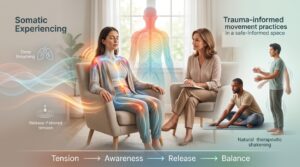
The traditions of shaking and tremoring take advantage of the body as natural stress-release mechanisms. Monitor animals following a threat- they literally shed off the stress hormones and get back to baseline. It is something that humans tend to repress, and they get the activation as a trap in our systems. Trauma Release Exercises (TRE), invented by Dr. David Berceli, involve the use of certain stretches that activate the natural tremoring mechanism of the body to enable the nervous system to release tension (Berceli, 2008).
Another way of releasing trauma is through dance and genuine movement. Once our bodies are left to move freely without choreography and without judgment, the repressed feelings and memories can be brought out and be played out without the use of words. According to research in the American Journal of Dance Therapy, dance movement therapy assists trauma survivors to process the traumatic memories, decreases dissociation and enhances body awareness (Koch et al., 2019).
Breathwork and the Vagus Nerve
The breath provides a connection between the conscious and unconscious, the voluntary and the involuntary nervous systems. Trauma normally causes shallow and chest-based types of breathing that keep the body in a state of stress. The intentional alteration of our breathing rhythms can alter our nervous system, either putting us in the sympathetic (fight-or-flight) or in the parasympathetic (rest-and-digest) mode of activation (Porges, 2011).
The vagus nerve is the longest cranial nerve of the body, which is important during recovery after TRAM. This is the nerve that links the brainstem to many organs, such as the heart, lungs, and the digestive system and is the primary constituent of the parasympathetic nervous system. The nervous system can be controlled by the stimulation of the vagus nerve by using certain breathing exercises, humming or cold, which will free the tension associated with the traumatic events (Porges, 2011).
Diaphragmatic breaths, also known as belly breathing, mean breathing into the lower abdomen as opposed to chest breathing. This triggers the diaphragm and vagus nerve, which indicates that it is safe for the body. You have to practice putting one hand on your belly and the other on your chest. Breathe in very slowly with your nose and feel your belly rising, and the chest remains comparatively stable. Breathe out gradually with the mouth. Exercise for five to ten minutes a day.
The Navy SEALs use an exercise known as box breathing to keep calm during stress, and it is based on the following: breathing in (one count), breathing out (one count), breathing in (one count), and breathing nothing in (one count). This rhythmical pattern disrupts stress reactions and restores the nervous system. Parasympathetic response is facilitated especially by deep breathing in which the exhale is longer than the inhale, which disrupts trauma release and relaxation (Harvard Medical School, 2021).
Bodywork and Manual Therapies
Touch therapies are very healing to trauma stored in the body, but it has to be used with care and only with well-trained practitioners who know about trauma. Complicated relations with touch are also a common feature of trauma survivors, and bodywork should be based on the principle of safety, consent, and the empowerment of the client. Craniosacral therapy involves light touch, and it is applied to hindrance restrictions within the craniosacral system -membranes and fluid that encompass the brain and the spinal cord.
Practitioners document that this subtle work can assist in releasing deeply held patterns of trauma, even though there is limited scientific study on the mechanisms of such work. The most important thing is that, according to many trauma survivors, this non-invasive method brought them much relief (Upledger Institute, 2020).
Myofascial release treats the connective tissue (fascia) which encloses muscles and organs. Trauma may lead to restriction of fascia and tightening, which is the cause of chronic pain and limited movement. By sustained pressure and stretching, the practitioners can relieve these restrictions with the help of skilled practitioners. The research in the Journal of Bodywork and Movement Therapies indicates that myofascial release may help alleviate pain and enhance the functionality of people with chronic pain disorders, which may be associated with trauma (Ajimsha et al., 2015).
Although acupuncture has Chinese traditional medicine roots, it has potential in the recovery of trauma because of the effects of acupuncture on the nervous system. Studies show that acupuncture has the ability to balance cortisol levels, inflammation and activation of the parasympathetic nervous system. The Journal of Nervous and Mental Disease reported that a combination of acupuncture and therapy was very effective in treating PTSD as compared to therapy (Hollifield et al., 2007).
Practices You Can Start Today
You do not have to wait until you get professional treatment to start releasing the trauma out there. Some evidence-based practices may be initiated alone, and some become safer and more effective when collaborating with a trauma-informed practitioner. Progressive muscle relaxation is a method that involves the systematic contraction and relaxation of varied muscles. It becomes more aware of your points of tension and your body learns the distinction between tension and relaxation.
Begin with your feet, six seconds of tightness in the muscles, then relaxation. Make slow movements towards the upper part of your body. Exposure to cold water activates the vagus nerve and may help to re-set nervous system. Begin with a little splash of cold water on your face, ice cubes or spend the last 30 seconds of your shower with a little cold water. Feel without struggling, letting your breathing settle. The grounding methods are useful when you feel crushed by the feelings of trauma.
The 5-4-3-2-1 method consists of finding five things that can be seen, four that can be touched, three that can be heard, two that can be smelled, and one that can be tasted. This puts you in the present and disrupts traumatic activation. The vagus nerve is stimulated by humming, chanting or singing by the vibration of the vocal cords. Regulatory influences on your nervous system can be obtained even merely by humming a favourite melody whilst cleaning the dishes.
The Importance of Professional Guidance
Although numerous somatic practices can be considered as a single entity, having trauma-informed professionals allows being safe and getting the most out of it. Sometimes it is overwhelming as you release the trauma and a skilled guide will help you keep within your window of tolerance, not so high that you will be overwhelmed to the extent of traumatisation.
Find practitioners trained in somatic therapies such as Somatic Experiencing, Sensorimotor Psychotherapy or trauma-sensitive yoga. Make sure that the bodywork practitioners possess special training in trauma-informed care. The connection you have with your practitioner is as important as the method of doing it- you should feel safe, respected, and in control of the process of healing.
Conclusion
The body is not an instant cure, as it is a process of reconnecting with the body to release trauma. Something has been attempting to be said to you by your body in the one language it understands, that of sensation, tension, and physical symptomatology.
Learning to listen will enable you to finally allow your nervous system to finish what it had not been able to finish when you experienced a trauma. With the help of somatic practices, breathwork, movement, and touch, you will be able to turn your body into a jail of painful experiences into a source of healing and strength.
References
Ajimsha, M. S., Al-Mudahka, N. R., & Al-Madzhar, J. A. (2015). Effectiveness of myofascial release: Systematic review of randomized controlled trials. Journal of Bodywork and Movement Therapies, 19(1), 102-112.
Berceli, D. (2008). The revolutionary trauma release process. Vancouver: Namaste Publishing.
Brom, D., Stokar, Y., Lawi, C., Nuriel-Porat, V., Ziv, Y., Lerner, K., & Ross, G. (2017). Somatic experiencing for posttraumatic stress disorder: A randomized controlled outcome study. Journal of Traumatic Stress, 30(3), 304-312.
Emerson, D., & Hopper, E. (2011). Overcoming trauma through yoga: Reclaiming your body. Berkeley, CA: North Atlantic Books.
Harvard Medical School. (2021). Relaxation techniques: Breath control helps quell errant stress response. Boston, MA: Harvard Health Publishing.
Hollifield, M., Sinclair-Lian, N., Warner, T. D., & Hammerschlag, R. (2007). Acupuncture for posttraumatic stress disorder: A randomized controlled pilot trial. Journal of Nervous and Mental Disease, 195(6), 504-513.
Koch, S. C., Kunz, T., Lykou, S., & Cruz, R. (2019). Effects of dance movement therapy and dance on health-related psychological outcomes: A meta-analysis. The Arts in Psychotherapy, 41(1), 46-64.
Levine, P. A. (2010). In an unspoken voice: How the body releases trauma and restores goodness. Berkeley, CA: North Atlantic Books.
National Institute of Mental Health. (2023). Post-traumatic stress disorder. Bethesda, MD: National Institutes of Health.
Porges, S. W. (2011). The polyvagal theory: Neurophysiological foundations of emotions, attachment, communication, and self-regulation. New York: W.W. Norton & Company.
Upledger Institute. (2020). Craniosacral therapy: What you need to know. Palm Beach Gardens, FL: Upledger Institute International.
Van der Kolk, B. A. (2014). The body keeps the score: Brain, mind, and body in the healing of trauma. New York: Viking Press.
Van der Kolk, B. A., Stone, L., West, J., Rhodes, A., Emerson, D., Suvak, M., & Spinazzola, J. (2014). Yoga as an adjunctive treatment for posttraumatic stress disorder. Journal of Clinical Psychiatry, 75(6), 559-565.
See Also:



This article on somatic healing is clear and easy to understand. I like the fact that the evidence-based, simple techniques such as focused breathing and mindful presence in the moment can be really helpful in managing distress and trauma.